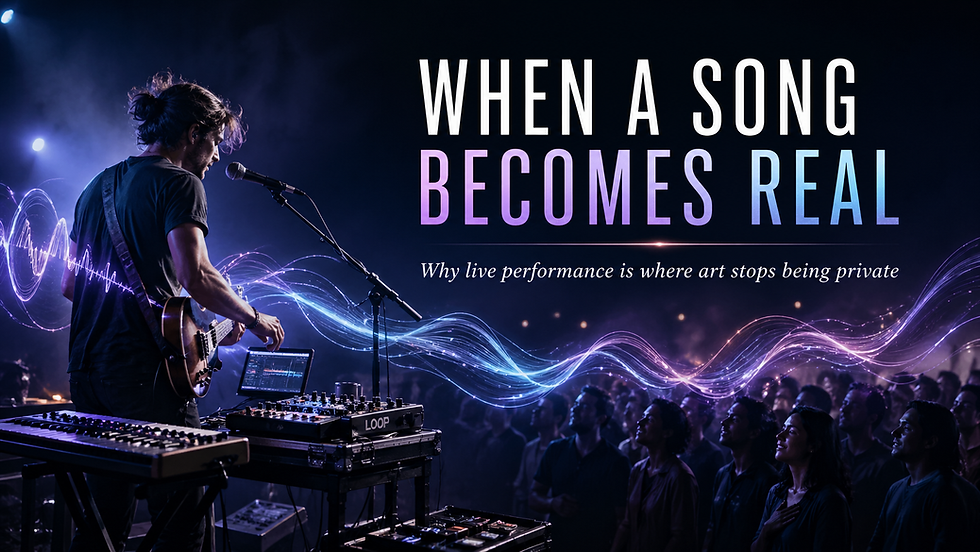
When a Song Becomes Real

Why live performance is where art stops being private
A recorded song is a strange thing. In one sense, it can take hours, days, weeks, or even months to make. It can demand technical skill, emotional honesty, patience, revision, and a level of obsession that most people will never see. And yet, until somebody other than the person who made it actually hears it, connects with it, and experiences it, it is still just a thing. It is a file. It is an arrangement of sounds. It is potential waiting for contact.
That idea has been on my mind a lot lately, especially while thinking about the difference between finishing a song in the studio and preparing that same song for live performance. In the studio, a song can feel complete because the work is complete. The parts are recorded. The mix is balanced. The effects are in place. The mastering is done. Everything is where it belongs. But completion and connection are not the same thing. A song can be finished and still not have lived yet.
That is one of the reasons live performance matters so much. In previous episodes, I have talked about how live music is one of the last places technology still has not fully replaced the human element. Tools can help us write. Tools can help us arrange. Tools can help us mix. Tools can even generate convincing ideas. But the moment when another person hears a song in real time, responds to it, leans in, smiles, disengages, or feels seen by it, that part still belongs to people. That is where art stops being private and starts becoming relational.
This week’s vlog came out of that thought. I wanted to talk about what it actually means to take a finished song and get it ready for a live setting. Not just how to play the notes, but how to make the song transferable. How to move it from a controlled studio environment into a space where it has to breathe, respond, and adapt. Because if art is meant to connect, then part of the process is learning how to make room for that connection to happen.
That is where live performance changes the conversation. A recorded song exists in a fixed form. It does what it does the same way every time. A live song is different. A live song has to survive contact with people. It has to work in a room. It has to carry enough structure to hold together, but enough flexibility to respond when the moment asks for something different. Sometimes a section needs to be shorter because the energy is not there. Sometimes it needs to be longer because the crowd is locked in and the song is doing more than it did in the studio. A live arrangement gives the music a chance to become an experience instead of just a product.
That is why I do not think preparing a song for performance is just a technical exercise. It is not only about signal flow, MIDI drums, loopers, backing tracks, or pedal assignments, even though all of those things matter. It is really about deciding how much of the song needs to stay fixed and how much of it needs to remain alive in your hands. The more rigid the setup, the easier it may be to reproduce the track exactly. But the more flexible the setup, the more room there is for the song to become something shared instead of something merely repeated.
That tradeoff shows up in all kinds of art, not just music. A painting in a studio is paint on canvas until somebody stands in front of it long enough to feel something. A story is words until somebody recognizes themselves in it. A photograph is composition and light until it reminds someone of a memory they forgot they had. Art becomes art in a deeper sense when it leaves the creator and enters another person. The making matters, but the meeting matters too.
I think that is why so many artists feel restless even after they finish something. Completion does not always satisfy us because deep down we know the work is only halfway done. It still has to be received. It still has to be heard, seen, witnessed, or felt. Until then, it remains unfinished in another sense. Not technically unfinished, but relationally unfinished. The bridge between creator and audience has not been crossed yet.
For musicians, live performance is one of the clearest ways that bridge gets built. It is where songs stop being isolated layers in a session and start becoming moments with other people. It is where timing becomes more than tempo. It is where dynamics become more than volume. It is where the audience tells you, sometimes without words, whether the song is connecting. And that feedback changes the musician too. You learn what breathes. You learn what drags. You learn what opens a room up and what closes it down. You learn that a song is not only something you control, but something you steward.
That is one of the most valuable lessons I ever picked up playing in churches. More than almost anywhere else, church playing teaches you that the arrangement on paper is not the final authority. You learn to listen. You learn to stretch when the moment needs space. You learn to move on when it does not. You learn that the room matters. You learn that people matter. Those are not small lessons. They are central ones. They remind you that music is not just about getting through material correctly. It is about helping create an experience people can enter.
That is also why I keep coming back to the idea that the real value in music is not found in streams. Streams can measure access. They can measure repetition. They can sometimes measure reach. But they do not fully measure connection. Live performance is where connection becomes undeniable. It is where the song has to stand on its own without the safety net of perfect conditions. It is where the artist finds out whether the work can actually live in the world.
So this week’s vlog is about gear and setup, yes. It is about drums, loop building, keyboard splits, signal flow, and dynamic control. But underneath all of that, it is really about a bigger question. How do you take something you made in private and prepare it to matter in public? How do you build a performance system that does not just recreate a recording, but creates space for a real moment to happen?
Because that is the goal, at least for me. Not just to finish songs, but to let them become experiences. Not just to make art, but to share it in a way that gives it a chance to connect. A recorded song is a thing. A performed song is a conversation. And when somebody on the other side of that conversation hears it, feels it, and carries a piece of it with them, that is when the work becomes more than sound.
That is when it becomes alive.
Around here, that is really what this whole thing is about. Not just collecting gear, not just learning new tools, and not just proving what can be done on a portable setup. It is about taking ideas that start in private and building them into something another human being can actually feel. That is the point. That is the work. And that is why live performance still matters so much.
Until next time, may your gear be light, your latency low, and your songs find their way into somebody else’s ears at exactly the right moment.


Comments